


Specialised interpreting for universities and research centres
Azucena Intérpretes provides technical and academic interpreting services for conferences, seminars and research workshops. Our experience includes collaborations with prestigious institutions such as Trinity College Dublin, University College Dublin (UCD), Maynooth University and Pontificia Universidad Javeriana, ensuring that the rigour of the original research is conveyed with precision.
Why is academic interpreting different?
Management of methodological density: Accurate rendering of terminology relating to data analysis, statistics, theoretical frameworks, sampling processes and research methodologies
Adaptation to cutting-edge registers: In conferences on sustainability or medicine, terminology often includes neologisms that require in-depth research from primary sources prior to the event.
Ability for abstraction: Capacity to handle complex conceptual frameworks, from Jacques Lacan’s psychoanalytic theory to systems of property rights and social justice.
Neutrality in high-impact social topics: Experience in handling sensitive discourse on human rights, gender, refugees and poverty, while maintaining impeccable terminological accuracy.
Our Added Value:
At Azucena Intérpretes, we bring the research-level rigour required by the academic sector, facilitating the exchange of knowledge within prestigious institutions through:
Rigorous documentation and specialisation: We study scientific articles and primary sources in order to manage highly complex events. Our work stands out in Sustainability (URBACT/Trinity College, UPV), Justice and Mediation (Pontificia Universidad Javeriana, Queen’s University Belfast, Kylemore Abbey) and Social Geography (Maynooth University).
Versatility and conceptual precision: We are equally proficient in keynote lectures and technical laboratory visits, ensuring accuracy in areas such as Immunology and Vaccines, Humanities (Joyce–Lacan Symposium), International Education (DCU) and specialist seminars on minority languages.
Commitment to scientific accuracy: Our working methodology ensures that the nuance of every finding or theory is preserved intact. This fidelity to the original discourse is what has made us a trusted partner for research centres requiring unambiguous communication, where every technical term is treated with the importance it deserves.


METHODOLOGICAL AND CONCEPTUAL RIGOUR
In the university context, language serves as the vehicle for complex theories and critical methodologies. Specialised interpreting ensures that every concept, however abstract, preserves its integrity. This requires a deep command of academic register, enabling technical terminology and theoretical frameworks to be conveyed with complete fidelity to the original meaning of the research.


INSTITUTIONAL AND MULTIDISCIPLINARY COOPERATION
International research projects and inter-university meetings are the driving force behind scientific progress. Professional interpreting acts as the essential bridge for collaboration between global teams, facilitating dialogue in institutional visits, governing board meetings and working groups. Our work ensures that language barriers do not hinder synergy between specialists from different disciplines and geographical regions.


KNOWLEDGE TRANSFER AND DISSEMINATION
The mission of universities is for knowledge to extend beyond their own walls. Interpreting at congresses and seminars enables scientific findings to reach an international audience. By ensuring precise communication in cutting-edge forums, from the social sciences to technical and healthcare innovation, we help research outcomes to be shared with clarity, thereby enhancing their global impact.
AREAS OF ACTIVITY IN THE UNIVERSITY AND RESEARCH CENTRES SECTOR
Interpreting in academic and R&D environments
Congresses and symposia: Coverage of international scientific events, research conferences and high-level specialist seminars.
Cooperation and innovation: Support in European project meetings (R&D&I) and strategic encounters between universities, technology centres and the business sector.
Training and debate: Interpreting for lectures, panel discussions, publication presentations and thesis or study defences.
Scientific outreach: Facilitating communication in public lectures and events that connect science with society.
Modes of interpreting for academic events
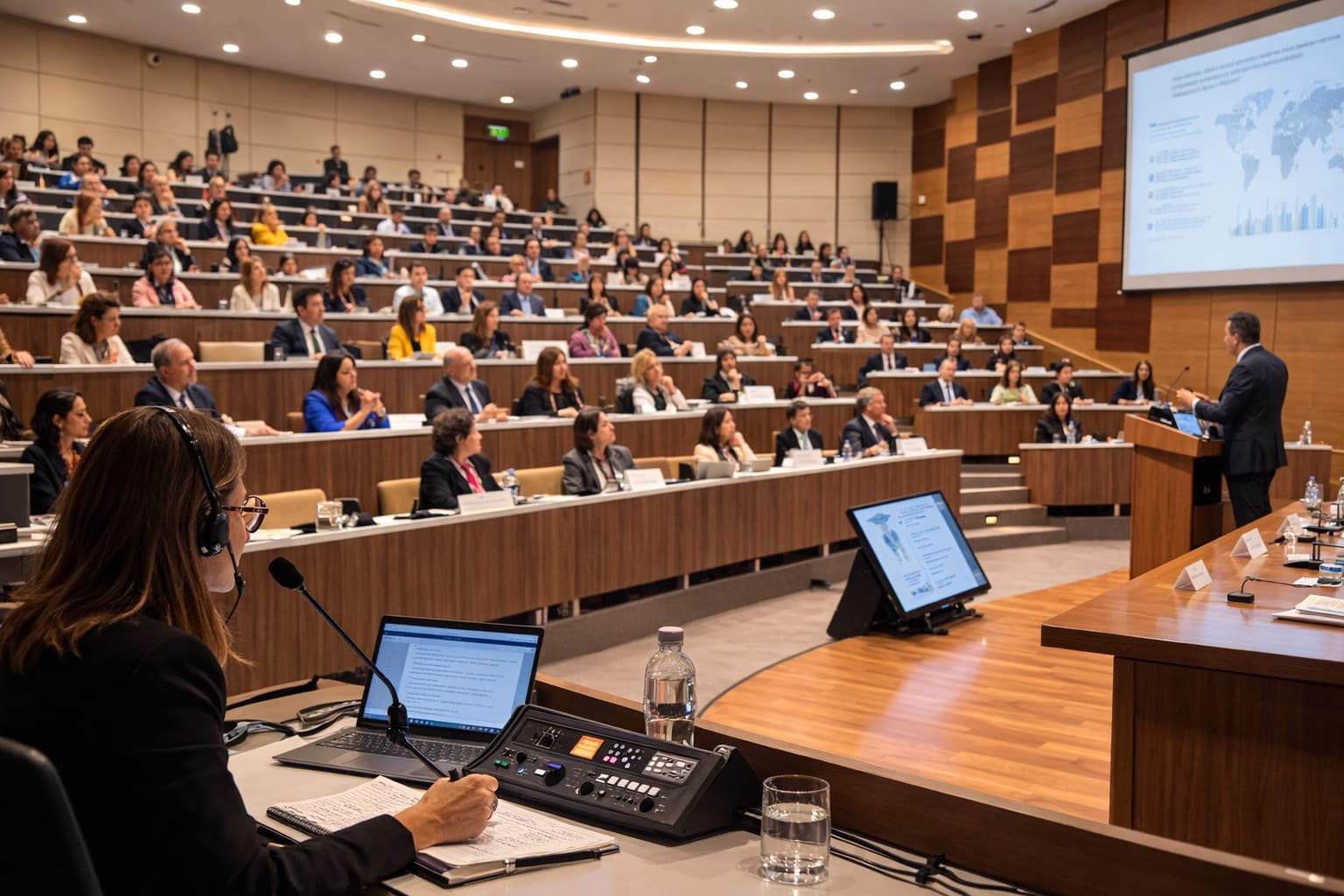
Simultaneous interpreting in a booth – ideal for international university congresses and scientific conferences with large audiences.
Bilateral interpreting – suitable for working meetings between researchers, universities or international scientific teams.
Consecutive interpreting – used in academic seminars, lectures or research presentations.
Remote and hybrid interpreting – for online seminars, academic webinars and virtual international meetings.
Portable equipment interpreting – useful for academic visits, university meetings or activities on campuses and research centres.
Technical event supervision to ensure sound quality, stability and uninterrupted operation.
FREQUENTLY ASKED QUESTIONS
Where is Azucena Intérpretes based?
Azucena Intérpretes is based in Valencia, from where it coordinates conference interpreting services for companies, institutions and organisations. However, its reach is both national and international, providing services across Spain, Europe and other countries, in both on-site and remote or hybrid formats.
Do you provide conference interpreting outside Valencia?
Yes. Although the company is based in Valencia, simultaneous and consecutive interpreting services are provided in any city in Spain or abroad. Thanks to an international professional network, full teams are also coordinated for scientific congresses, academic seminars, international research projects and university events.
What materials does the interpreter need to prepare?
Prior preparation is essential to ensure accurate interpreting in academic and scientific contexts.
Whenever possible, we request organisers to provide materials such as:
A detailed programme of the congress or seminar.
Speakers’ presentations (slides).
Relevant academic articles or scientific documentation.
Specific terminology related to the field of research.
This allows for the preparation of specialised terminology and a better understanding of the content of each presentation.
Does Azucena Intérpretes also provide technical equipment management?
Yes. In addition to interpreting services, a comprehensive technical equipment management service is offered, including:
Interpreting booths
Sound systems
Individual receivers
Portable systems such as Infoport
Full technical coordination of the event
This ensures that clients can focus on content and strategy, while multilingual communication is handled by experienced professionals.
How far in advance should an interpreting service be booked?
It is advisable to book the service several weeks in advance, particularly in the case of scientific congresses or international academic events that require technical planning.
The earlier the service is confirmed, the easier it is to coordinate specialised interpreters and properly prepare the event documentation.
Is it necessary to hire two interpreters?
For simultaneous interpreting assignments lasting more than 45 minutes, international quality standards require interpreter teams of two. This ensures that concentration and accuracy do not decline, as interpreters take turns every 20–30 minutes to maintain the highest level of precision and rigour.
LEAVE THE ORGANISATION OF UNIVERSITY AND RESEARCH CENTRE EVENTS IN EXPERT HANDS
Entrust the interpreting of your university congress, research conference or academic event to specialists in high-level multilingual communication.
WE HAVE PROVIDED OUR VOICE
We have worked at international university congresses, research conferences, academic seminars and scientific meetings organised by universities, research centres, business schools and academic institutions, facilitating communication between researchers, lecturers and specialists from different countries.